Fixed Practice Night or Flexible Window?
Choose a fixed practice night or flexible window by comparing club rules, session formats and the kind of commitment that helps you turn up ready to play.
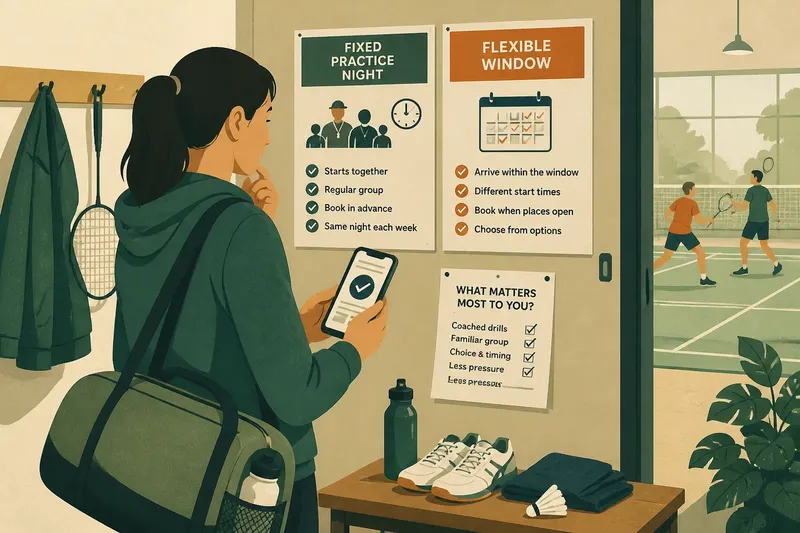
You have your kit by the door when the club message arrives: Thursday’s court session is full, but there is space at a Saturday drop-in. A fixed practice night gives you one regular appointment; a flexible window lets you choose among available sessions. The better fit depends less on predicting your calendar and more on what the club offers and how you prefer to take part.
Compare the two formats by checking the session rules, the people and equipment needed, and how much choice you want at the point of booking. Then use the checklist below to make a decision you can act on.
Start with the club’s actual session options
Ask the organiser for the current timetable and the rules for each session. A weekly club night might mean a coached group that starts together, while a drop-in could allow players to arrive during a wider period. The label alone does not tell you whether you can join late, miss a week or switch to another session.
Check how places are assigned, too. A badminton club may need players to book so it can organise courts and pairings; a running group may ask members to meet at a particular starting point. If sessions have limited access or require advance booking, treat that as part of the format rather than an administrative detail.
- Session start: If everyone must be ready for a coached warm-up, choose the fixed slot only if you can arrive on time; otherwise ask about another group.
- Late arrival: If late entry is allowed, a fixed night may still work with occasional delays; if it disrupts drills, choose a session with a later start or a flexible option.
- Booking: If each session needs a reservation, choose a flexible window only if you can book when places open; otherwise ask whether a regular place is available.
- Attendance expectation: If the club expects the same players each week, favour a fixed night if you can attend regularly; if attendance is casual, a flexible window may suit better.
- Alternative sessions: If another suitable session is available when you miss your usual one, a flexible arrangement has a real fallback; if not, decide whether the single fixed slot is realistic.
- Equipment or partners: If you need club equipment or a partner, check that the alternative session provides them; if it does not, choose the session where those needs are covered.
Choose from sessions you are allowed and equipped to join, not from names on a timetable alone.
Compare the commitment each format asks of you
A fixed practice night turns attendance into a standing appointment. That can reduce the need to choose each week and may help when familiar teammates, a coach or a regular group make practice easier to begin. Its drawback is that a repeated clash can make the appointment hard to keep.
A flexible window gives you control over which available session to attend, but it leaves a decision to make. It suits someone who likes choosing from confirmed options and can complete booking or travel arrangements in time. If choosing tends to become postponing, set a specific cue for making the selection.
Say your club offers a Tuesday coached session and a Saturday open court. You prefer the coach’s drills, but your evening class ends close to Tuesday’s start; the organiser says late entry misses the main exercises, while Saturday allows players to join later. If improving through the coached drills matters most, choose Tuesday only when you can arrive on time; if arriving without rushing matters more, select Saturday and accept the less structured session.
Make the trade-off explicit: do you value a known group and structure, or choice and a less fixed commitment?
Match the format to the kind of practice you want
Some activities depend on other people, shared equipment or a coach. Team sports and partner-based sessions can make a regular group especially useful, while solo practice may offer more freedom about where and when to take part. Check the details of your own club before assuming that an individual activity is automatically flexible.
Also consider what counts as a satisfying session for you. If you want coached drills, a casual open session may not be a genuine substitute. If your aim is simply to spend time practising a skill, a less structured slot may provide enough room to work.
Ask the club whether newcomers can try more than one format, whether there is a suitable session for your experience level, and what to bring. A short conversation can clarify whether “flexible” means several comparable options or a choice between quite different activities.
Choose a format using the club’s rules and your preferred cue
Use a fixed practice night when the session’s start, attendance expectations and group structure suit you, and a standing appointment helps you commit. Choose a flexible window when the club offers genuinely suitable alternatives and you are comfortable selecting one rather than relying on a single regular group.
Before settling on either, complete these checks and follow the decision attached to each result:
- Check the start time: If you can reliably arrive ready for the session’s first activity, keep the fixed option; if not, ask for a later or more flexible session.
- Check booking rules: If you can reserve a place in advance, keep flexible sessions in consideration; if booking is uncertain or often closes before you can act, ask about a regular place.
- Check group continuity: If familiar partners or a coach matter to your practice, choose the session where those people are consistently available; if not, compare sessions by access and structure.
- Check what happens after a missed night: If the club offers a suitable alternative, a fixed night with a fallback may work; if it does not, choose only if you can protect that one session.
- Check the activity itself: If the flexible option gives you the coaching, equipment or partners you need, it is a real alternative; if it changes the kind of practice too much, favour the format that meets your aim.
- Check your decision cue: If a regular appointment prompts you to attend, choose the fixed night; if you can select from confirmed options and book promptly, choose the flexible window.
For a middle ground, ask whether you can keep one regular session and occasionally attend another when the club permits it. Do not rely on switching until the organiser confirms the rules.
Questions to settle before choosing?
Can I arrive late to a fixed practice night?
Ask the organiser whether late arrival is allowed and what you would miss. If the session begins with essential warm-ups or team assignments, choose a later session rather than assuming you can join midway.
Does a flexible practice window mean I can turn up without booking?
Not necessarily; some clubs require a reservation or cap attendance. Check the booking process and choose the flexible option only if you can follow it.
What if the flexible sessions offer different kinds of practice?
Compare what each session actually provides, including coaching, partners and equipment. If only one option meets your practice aim, treat that as your preferred session rather than counting every time slot as interchangeable.
Can I combine a regular night with occasional alternatives?
Some clubs allow members to attend another session when space permits, while others assign people to a specific group. Ask before planning around a fallback, then use it only as the club allows.
Make the final choice from the session details
Choose the fixed night if its structure and group suit you and you can meet its attendance expectations. Choose the flexible window if its alternatives are genuinely comparable and you are prepared to make the booking or selection promptly.
For a fixed practice night or flexible window, the useful distinction is whether you want one dependable club appointment or a choice among confirmed ways to practise. Check the timetable and rules again before joining; a clear understanding of what each session offers makes it easier to arrive ready to take part.