Why Small Club Jobs Keep a Season Moving
Small club jobs keep a season moving by clarifying who does what, making it easier to share recurring duties and helping members choose a manageable role.
The nets are still rolled beside the court when the first players arrive, and nobody knows who has the equipment cupboard key. Small club jobs keep a season moving by turning these everyday details into shared responsibilities instead of an unspoken burden for the same familiar helpers.
Setting out cones, checking the sign-in sheet or returning bibs to the right bag may seem minor beside training and competition. The practical question is how to divide these tasks so members can contribute reliably without turning volunteering into another full-time commitment.
Small club jobs make sessions easier to coordinate
A club session depends on practical details: someone opens the venue, equipment is ready, players know where to gather and the space is left tidy. If nobody is assigned a task, a routine job can become a last-minute scramble.
Not every task needs a formal role. Members do need to know what must be done, who has agreed to do it and how to arrange cover if plans change. A simple rota or task list can provide that clarity without adding layers of administration.
Shared notes also help the club rely less on one person’s memory. If only one volunteer knows where the spare balls are or how the venue is left at closing, their absence can disrupt the routine. Keep useful details somewhere members already check, such as a noticeboard, shared message group or folder with the equipment.
Record the task, the person covering it and how to arrange a swap. Leave out details that helpers do not need.
Choose a rota, helper pool or task owner
Most clubs can start with one of three arrangements: a rotating rota, a pool of occasional helpers or a named owner for each recurring task. Choose according to how predictable the work is and how members prefer to contribute.
A rota works for predictable duties
A rota suits jobs that recur in a familiar order, such as unlocking a changing room, setting out training markers or checking that kit is put away. Members take turns, and the schedule shows who is responsible before the activity begins.
Use a rota when attendance is fairly steady and the task is easy to explain. Make swaps straightforward, with a clear way to tell the next person and update the record. If members attend irregularly or a missed turn leaves the session short-handed, a fixed sequence may create frustration rather than clarity.
A helper pool works for occasional duties
A pool suits jobs that arise now and then, such as carrying equipment to an away venue, helping at an open session or tidying a storage area. Members can volunteer when they are available rather than being assigned a duty on a date they may not attend.
Describe the task clearly and ask early enough for people to respond. “Could two people arrive early to carry the kit bags from the entrance?” gives members a better basis for deciding than “Can anyone help?” Use a sign-up list to show whether the task is covered.
Requests can still fall repeatedly to the same willing people. Invite a broad group without pressure, and make it acceptable to decline.
A named owner works for duties needing continuity
Some jobs need one person to keep track of them, even when others do the work. A kit coordinator might notice that bibs need washing, remind members when bags should be returned and ask someone else to cover during an absence.
Define the role as coordination rather than an expectation that one person must do everything. Agree what the role includes, how long the person is taking it on and how someone else can learn the routine. A deputy or short handover note helps the task continue when the owner is unavailable.
Match the arrangement to the task and members
Start by asking when the task is needed and what it involves. A quick job that recurs predictably may suit a rota; an occasional task may suit a helper pool; work involving several connected actions may need a coordinator.
Then consider how members actually take part. Some arrive early every week, while others attend when work or family life allows. Offer different ways to help, such as a short task on the day, a communications job or a one-off event duty.
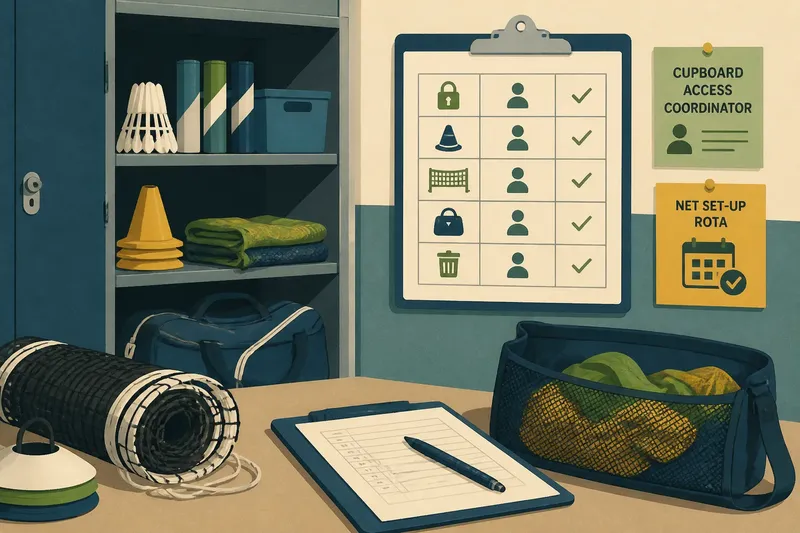
Say you run a badminton club where members arrive at different times and equipment comes from a shared cupboard. The starting point is that access needs coordination, while setting out nets is a separate, brief task. Ask one volunteer to coordinate cupboard access, then list net set-up as a rota duty for members attending each session. If a scheduled member cannot come, they message the group, arrange a swap and update the rota. The resulting arrangement shows who covers each job without placing access, set-up and every other task on one person.
Give each assignment a clear boundary. “Put out the cones before warm-up” is easier to assess than “help with training”. For an ongoing job, describe what needs to stay current, such as the equipment list, so a volunteer can decide whether the commitment suits them.
Make club jobs easy to follow and change
Write down the details a helper needs. For an equipment task, include where items are stored, what is needed for the session and where everything goes afterwards. For a venue task, follow the venue’s instructions and local rules.
Keep the note short enough to use at the club. A card attached to an equipment bag may be easier to find than a document buried in a message thread. Add duties to a shared calendar only if members reliably check it.
Make swaps ordinary. A member who cannot take a rota turn should know how to ask for cover, and the replacement should know the change has been recorded. Review the arrangement when the venue, schedule or routine changes; ask which tasks are being missed and whether any role has quietly grown too large.
- Check whether the task happens at every session; if it does, use a rota when attendance is steady, otherwise invite helpers as they are available.
- Check whether the task has a clear start and finish; if it does, assign that specific action, otherwise divide it into smaller duties.
- Check whether members know where the equipment is kept; if they do, point them to the usual storage place, otherwise add the location to the task note.
- Check whether a duty needs one person to track several actions; if it does, name a coordinator and arrange cover, otherwise use a rota or sign-up list.
- Check whether a member can attend the assigned session; if they can, confirm the duty, otherwise arrange a swap and update the record.
- Check whether the same volunteers keep covering unclaimed work; if they do, invite other members and reduce or split the task, otherwise keep the current arrangement.
- Check whether the venue or session routine has changed; if it has, revise the instructions and rota, otherwise leave the working arrangement in place.
What should clubs consider when sharing jobs?
How do you ask club members to volunteer?
Name the task, say when it needs doing and describe the effort involved plainly. Offer a direct way to respond, and make it acceptable to decline so members can answer honestly.
What if nobody takes a task on?
Break the job into smaller parts and check whether its timing or instructions are creating a barrier. If it remains uncovered, simplify the activity or find another workable arrangement rather than relying on an unspoken expectation.
How can a club share jobs fairly?
Fairness means distributing responsibilities in a sustainable way, not asking everyone to do an identical task. Make recurring duties visible, offer different options and notice if the same volunteers repeatedly cover gaps.
Does every club job need a named owner?
No. A recurring task that needs coordination benefits from a point of contact, while a straightforward one-off job may only need a sign-up list or rota. Choose the lightest arrangement that still makes responsibility clear.
Keep contributions manageable
A useful club job has a clear boundary, a visible place in the routine and a workable handover. If a duty grows, split it or invite another person to share it before the extra work becomes an unstated expectation.
Thank people by naming what they did. A straightforward message after a session can show that setting out equipment or updating a rota is part of the club’s shared work.
For small club jobs, start with one recurring task, decide whether it suits a rota, helper pool or coordinator, and record how a member can hand it over. That gives the next volunteer a clear place to begin and leaves more attention for the activity itself.